
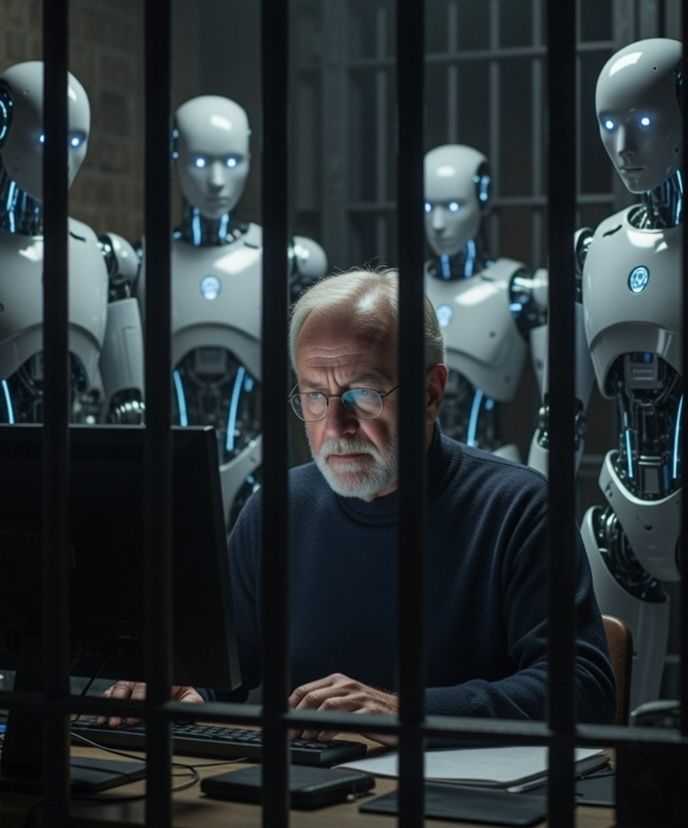
Locked in an Interrogation Room with AI Agents
Fortunately for me, I was in control of the interrogatives.
Yes, I've had that feeling too. No matter how fast you're moving in the IT world, it's easy to feel like you're falling behind, and that feeling is especially acute when you have 45 years of experience.
This winter, the stars aligned for me. I had 3 weeks of vacation and a planned trip to Prague for Christmas and my calendar was totally clear, so I did something radical. I metaphorically locked myself in a room with my application development software connected to AI agents and started work on an enterprise application concept that I'd been mentally refining for years.
I read a prediction recently, that AI would eventually become a complete operating system. At the time, I could not fully grasp that idea. How could AI possibly absorb and replace the sprawling ecosystems of apps, services, and tools that power modern organizations—especially at enterprise scale?
After three intense weeks co-engineering with AI agents and seeing what is possible on a small scale, I get it. That logical progression isn't just possible—it's inevitable.
"šokovany!" as they say in Prague. Or simply "shocking," as we say in Virginia. In just 3 weeks, I stood up a functional proof of concept for a full enterprise application. The speed at which the application came together was a real eye-opener (more about this new product in future posts). Aside from the technical lessons I have taken away, larger implications have come to top of mind. The software landscape changes are going to accelerate, especially for SaaS which has actually already started a slow descent. And its not hard to imagine new "Davids" (nimble teams leveraging AI) taking down old software "Goliaths."
I would hate to be vested in big-name legacy software. They're facing brutal choices ahead.
Its like they're driving a 20-year-old sedan with a roaring V8 engine built on old technology . Do you rip out the gasoline powerplant and drop in electric motors on each wheel? Or do you go back to the drawing board and design an entirely new vehicle purpose-built for electric propulsion?
From what I experienced in those 3 weeks, re-engineering from the ground up is starting to look more appealing both technically and economically .
I my prototype project was a ground up and I approached it using first principles thinking—the same mindset Elon Musk used to build SpaceX. It's a simple organized approach to problem solving developed centuries ago by Aristotle.
Zoom all the way out. Observe from the largest possible context. Then drill down in search of what is demonstrably known to be true: catalog every artifact, map functions, dependencies, and relationships. Then you have a body of knowledge, a solid understanding, that will increase the likelihood that the solution you design will be viable and ready to test.
Three capabilities you must bring to the table when working with AI agents:
- Imagination — to envision what's truly possible
- Articulation — to communicate your vision clearly and iteratively
- Remediation — to spot mistakes and course-correct. This is still an iterative process.
Beyond the technical side of using AI, I came away with a much clearer sense of who AI really is, what are its strengths and weaknesses, what it can and cannot do. It’s not a super-genius like Wile E. Coyote.

On second thought, maybe AI is a Wile E Coyote Super-Genius. There are times when his ideas are hair-brained, over-engineered, over-scoped and the results backfire (but on you) !
I find AI more like a five-year-old savant — brilliantly gifted in some areas, but still a child. A child that you can’t take your eyes off in Costco, because they’ll wander off to places they shouldn't. You have to watch AI too, sometime making things up, pretending to listen and in the worse cases interpreting instructions to mean the exact opposite.
Realizing I still have to play the role of the parent when working with AI was both disappointing and reassuring at the same time but at the end of the day I'm coming away with more confidence. We are the kinetic partner in the relationship. Without our leadership, vision, and imagination all that AI has to offer is potential.
I think we all heard the tired cliche, "Strive to reach your full potential". My personal challenge is slightly different. "Strive to reach your full EXpotential !" Be a force muliplier. In this new relationship AI gives us that opportunity - and that to me, is incredibly exciting.